The short answer is conditional, and anyone who gives you an unconditional yes is selling something. An AI automation agency is worth starting in 2026 if you are willing to learn three different jobs at once: implementation, sales and client service. It is a poor choice if what you actually want is to learn a few AI tools and collect monthly retainers while the software does the work. That version exists only in ads.
This guide walks through the four questions people research separately before committing: what the work really is, what it costs to start, whether you need a paid course, and how hard the first client actually is. It ends with a seven question test you can score in five minutes and a first step you can take in the next 48 hours.
What an AI automation agency actually does in 2026
Strip away the branding and the job is this: a business has a manual process that eats hours every week, and you replace it with software that runs on its own. The AI part is usually one component in a chain, not the whole product.
Typical deliverables that real operators describe in 2026:
- Lead response systems. A form submission or missed call triggers an instant, personalized reply, books a slot on a calendar and logs everything in a CRM.
- Data movement. Invoices, orders or applications that used to be retyped between systems now flow automatically, with AI reading the messy parts like PDFs and email threads.
- Content operations. One recorded video becomes a transcript, a newsletter draft, social posts and a summary for the team, on a schedule, with a human checking before anything publishes.
- Internal assistants. A chatbot trained on the company's own documents that answers staff questions instead of interrupting the one person who knows everything.
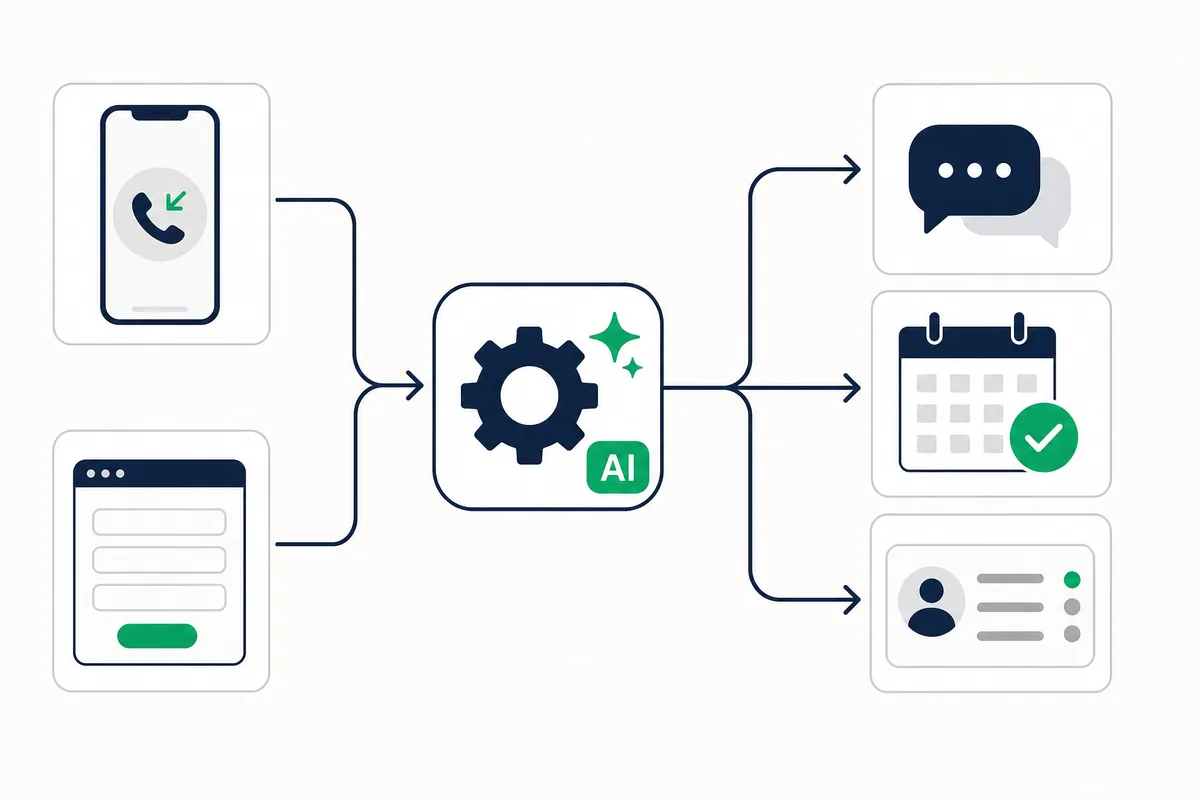
The tools behind this are mostly visual builders like Make, n8n and Zapier, plus API calls to language models, and data platforms like Apify that pull information from the web into those workflows. You do not need a computer science degree. You do need the temperament to debug a broken workflow while a client waits, because automations break, and maintaining them is part of the service whether you priced it in or not.
Is the market saturated? Yes and no, and the difference is the whole game
Spend an hour reading operator forums and you will find two groups arguing past each other. One says the market is finished, flooded, dead. The other is quietly signing clients. Both are describing the market accurately. They are just standing in different parts of it.
What is genuinely saturated: the generic layer. Thousands of people finished the same tutorials in the same month and are sending the same cold email: "I run an AI agency, want a chatbot?" Business owners now receive several of these a week. To them, one more vague AI offer is spam, and they treat it accordingly.
What is not saturated: the specific layer. The operator who walks into a dental practice and says "your front desk spends 90 minutes a day rescheduling no-shows by phone, I install a system that does it by text automatically, here is one working in a practice like yours" is not competing with the spam. They are barely competing with anyone, because being that specific requires work that template followers have not done: picking one industry, learning its actual daily friction, and building one demonstrable fix.

So the saturation question resolves into a positioning question. The market is closed to people selling "AI" and open to people solving a named problem for a named type of business. That distinction will come back in every section below, because it also decides what you should pay to learn and how you will get clients.
What the forums get right, including where they disagree
Community threads are the most honest data source on this topic, precisely because nobody is selling anything in them. Rather than pretending there is a consensus, here is the actual spread of recurring positions, because the disagreement itself is informative:
- "Learning the tools was the easy part." The most repeated sentiment. People report finishing courses, building dozens of practice workflows, and then hitting a wall at client acquisition. One widely discussed case involved someone with 15 to 20 finished projects and zero paying clients.
- "Courses oversell it." Strong agreement that much of the paid education repackages free documentation and undersells how hard selling is.
- "Specialists are doing fine." Operators who chose a vertical report steady demand, and several say referrals took over after the first few delivered projects.
- Disagreement: whether marketplaces work. Some report landing early gigs on freelance platforms. Others argue those platforms commoditize the service and attract clients who want automation for pocket change. There is no settled answer here, only a trade-off between easier access and worse economics.
- Disagreement: whether now is early or late. Pessimists point at the flood of new entrants. Optimists point at how few businesses have automated anything at all. Both facts are true simultaneously.
The pattern worth noticing: nobody in these threads fails at the automation. They fail at the business around it. Keep that in mind when you evaluate what to spend money learning.
Not sure which AI side hustle fits you? Start here
Our free ebook compares 5 practical ways to start a side hustle with AI: how to choose between them, how much time each one takes, what it costs to start and the first action to take. It is about a 15 minute read.
Get the free ebookWhat it costs to start: three budgets, not one number
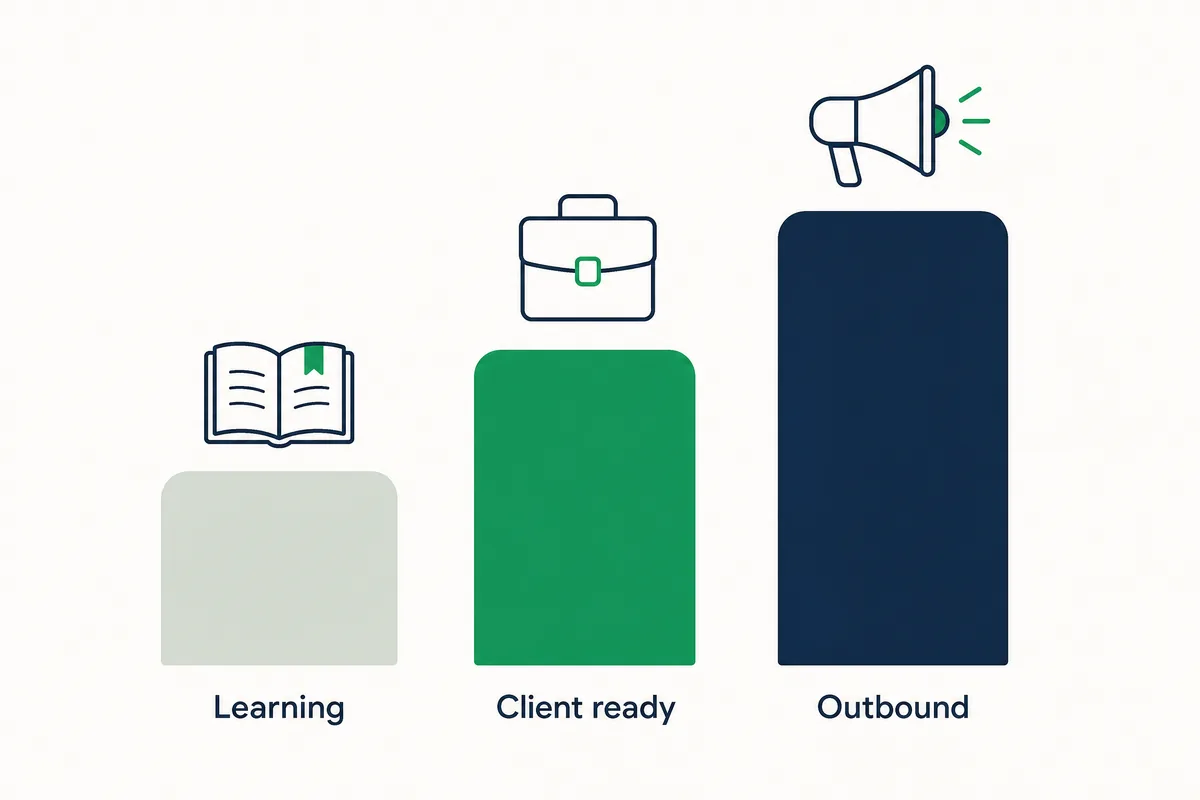
Search this question and you will find published guides that flatly contradict each other. Currently ranking pages put the startup cost anywhere from around 100 dollars to as much as 15,000, with several answers in between. They are not all wrong. They are answering three different questions without saying so: what it costs to learn, what it costs to be ready for a first client, and what it costs to prospect aggressively at scale.
Separated properly, the picture gets clear. Prices below are typical published rates as of mid 2026; check current pricing before budgeting.
| Stage | What it buys | Typical monthly range |
|---|---|---|
| Learning | Free tiers of Make or n8n, a language model subscription for building and testing, free documentation and community templates | 0 to 25 dollars |
| Client ready | Domain and professional email, paid tier of one automation platform, API credits for real workloads, a simple one page site, basic contract template | 50 to 150 dollars |
| Outbound heavy | All of the above plus lead data, a cold email tool with warmed inboxes, a CRM, possibly a virtual assistant for list building | 300 to 800 dollars |
Three practical consequences fall out of this table:
- You can validate the skill for close to nothing. The learning stage costs less than a streaming bundle. There is no financial excuse for skipping the test drive.
- The jump to client ready is small and worth delaying. Spend on it only after you have one realistic prospect conversation scheduled, not before. Tools do not create demand.
- The expensive tier is optional and often premature. The large budgets you see quoted assume industrialized cold outreach from day one. Most successful first clients in community reports came from warm contacts, local businesses and referrals, which cost time instead of money.
For the full itemized breakdown of all three budgets, the recurring stack, and a worksheet to price your own start, see how much it really costs to start an AI automation agency.
Do you need a course? What is free, and when paying makes sense
Here is the uncomfortable truth about paid education in this niche: almost everything technical is available free. Official documentation for the major platforms is excellent. Complete build-along projects sit on YouTube. Template libraries are shared openly in communities. If a course's main promise is "learn the tools," you are paying for sequencing, not for information.
That does not make all paid training worthless. It means the valuable part of a good program is everything that is not the tool tutorials, because those are the parts free content structurally cannot give you:
- Feedback on your specific offer. A generic video cannot tell you that your niche is too broad or your pitch is invisible. A person can.
- Live implementation help when your build breaks in a way the tutorial never covered.
- Sales practice. Watching someone sell is not the same as being coached through your own first calls.
- Current material. The tools change monthly. Recorded courses age fast; live programs can keep up.
A checklist before you pay for anything
Run any program, cheap or expensive, through these six filters. They apply to courses, communities, and live trainings equally, including anything we link to:
- It names a specific deliverable and audience, not vague "AI income".
- The curriculum spends real time on client acquisition and quality control, not just builds.
- Refund and access terms are written where you can read them before paying.
- It shows student work, actual systems built by learners, not just screenshots of dashboards.
- It sells without fake urgency. Countdown timers that reset are a data point about the seller.
- It is honest about ongoing costs and ongoing work, including tool subscriptions and client maintenance.
If a program fails two or more of these, keep your money regardless of how good the ads feel. If it passes, the decision reduces to whether structure and feedback are what you are currently missing, which is exactly what the self test at the end of this page tells you.
For the full version of this, what you can learn free, what to look for in a course, and when paying actually makes sense, see our guide to AI automation agency courses. And if the comparison above made freelancing sound like the better first move for you, we gave it its own honest look: is AI freelancing worth it in 2026.
The hard part is not the automation. It is the first client
This deserves its own section because it is the single most underweighted factor in every "start an AI agency" pitch, and the most repeated pain in every honest community thread.
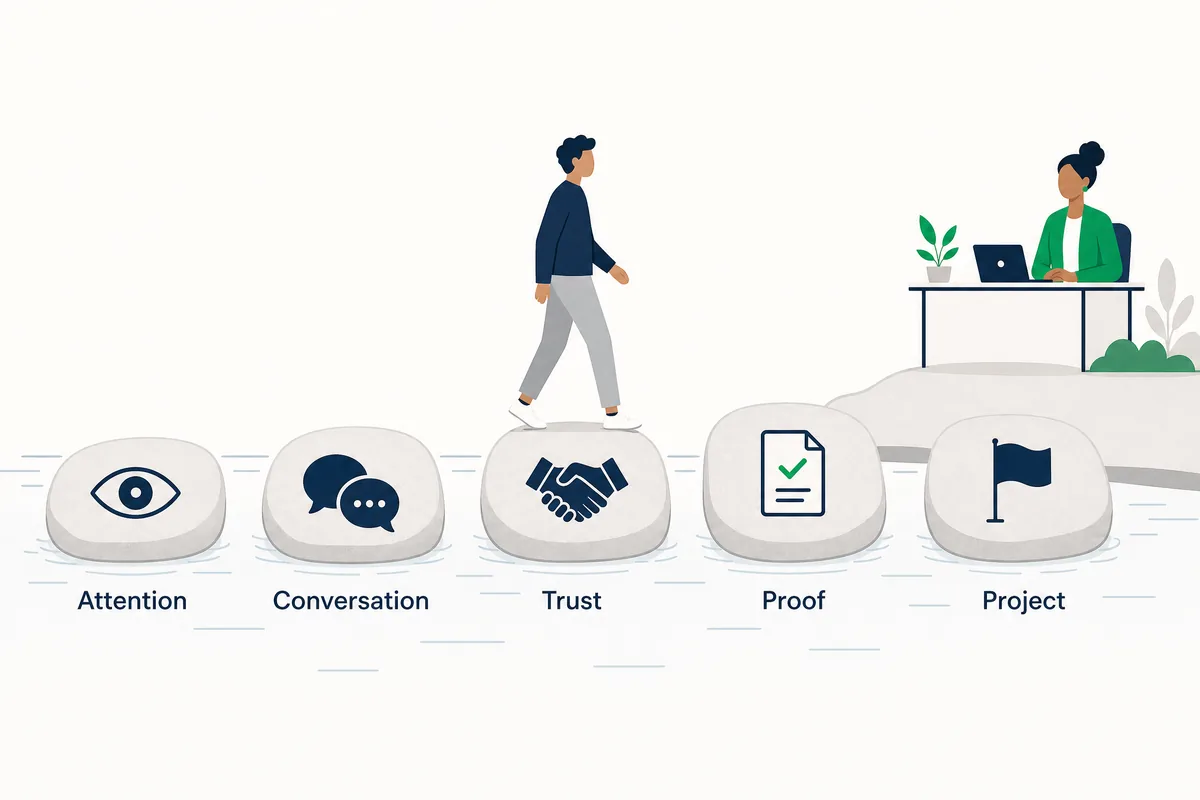
Learning happens at your speed. Client acquisition happens at other people's speed. A business owner did not wake up wanting an automation; they woke up wanting the pain to stop and not knowing software could stop it. Between your skills and their signature sits a chain you cannot rush: attention, a conversation, trust, a small proof, and only then a project.
What the operators who got through it describe, consistently:
- The first client was almost never a stranger. It was a former employer, a friend's business, a local shop they already knew, or a referral. Cold outreach worked for some, but later, once they had proof to show.
- A working demo beat every pitch deck. A two minute video of a system solving the exact problem, in the prospect's industry, did more than any description of capabilities.
- The offer was small. Not "let me transform your business with AI" but "let me fix this one thing, and if it works we talk about the next one."
- Follow-up carried more weight than the first contact. Most yeses arrived after the second or third touch, when the timing on the prospect's side finally matched.
If reading that list produces a quiet dread in you, pay attention to that feeling. It is the honest signal this guide exists to surface, and it feeds directly into the next section.
For the full playbook on this, where the first client really comes from and a message you can send this week, see how people actually get their first AI automation client.
Who should start one, and who should not
Most content on this topic only recruits. Here is the filter it leaves out.
| A reasonable fit if you | A poor fit if you |
|---|---|
| Can tolerate outreach, follow-up and being ignored for weeks | Hate selling and hoped the work would speak for itself |
| Enjoy talking to business owners about their operations | Want income without client calls or meetings |
| Can troubleshoot software patiently, including at bad hours | Lose patience the second time the same thing breaks |
| Want a client service business with recurring responsibility | Actually want passive income, if you are honest with yourself |
| Are willing to pick one industry and go deep | Prefer to keep every option open and stay generic |
| Accept that a course teaches skills, not customers | Expect a program to supply the clients |
Landing mostly in the right column does not mean you failed a test. It means this specific business model, which is a service business with software inside, does not match what you want from your time. That is worth knowing before the spend, not after. Other AI paths weight these demands differently, which is the next section.
How the agency path compares to other AI routes
Comparing by projected earnings is how people get misled, so this table compares by demands. Same skills universe, very different daily realities:
| Path | Technical bar | Selling required | Startup cost | Ongoing client work | Speed to test it |
|---|---|---|---|---|---|
| Automation agency | Medium | High, B2B | Low to medium | High, systems need maintenance | Weeks |
| AI-assisted freelancing | Low to medium | Medium, per project | Very low | Medium, per deliverable | Days |
| Digital products (where to sell them) | Low | High, but to an audience | Low | Low | Weeks, demand is the hard part |
| Content plus AI | Low | Indirect, audience building | Low | Constant production | Months |
Notice what the table implies: the agency route has the heaviest combination of selling plus ongoing responsibility, and in exchange it is the one where a single satisfied business relationship can compound into referrals and recurring work. Freelancing is the gentler on-ramp into the same skill set, and for many people it is the smarter first move. If that is the fork you are standing at, weigh it honestly before defaulting to the agency label just because it sounds bigger.
The seven question test: score yourself in five minutes
Answer yes or no. Count your yeses.
- Am I genuinely willing to contact businesses, follow up, and be ignored, for weeks, without taking it personally?
- Am I comfortable getting on calls with business owners and asking about their operations?
- When software breaks, do I get curious rather than furious?
- Do I want clients and their problems, rather than an audience or a passive product?
- Can I protect at least five focused hours a week for this, consistently, for six months?
- Can I name, right now, one industry I know something about and one manual task inside it that wastes hours?
- If I paid for training, would I use it for feedback and structure, rather than as a substitute for doing the uncomfortable parts?
4 or 5: fixable gaps. Look at which questions got the no. If it was 1 or 2, the gap is sales tolerance and no tool course fixes that; structured training with sales practice might. If it was 6, you need niche research before anything else.
3 or fewer: do not start an agency right now, and treat that as a useful result, not a defeat. Look at the freelancing column in the table above; it demands less of exactly what you said no to.
Apply it today: the 48 hour first step
If you scored well, do not buy anything yet. Run this two day exercise first. It costs nothing and produces the two assets every next step depends on, whether you go self-taught or into a program.
Day one: write your offer sentence
Fill this template with real words. Vague entries mean you are not done:
A weak version reads "I help small businesses save time with AI." A working version reads "I help real estate agencies stop manually copying leads from portals into their CRM by installing an automation that syncs them instantly, delivered in one week." The difference between those two sentences is the difference between the saturated layer and the open one from earlier in this guide. Rewrite it until a stranger could tell exactly who it is for and what it removes.
Day two: build the evidence list
- List five real businesses of that type you could plausibly reach: places you know, places a friend works, local firms you already interact with.
- For each, write the one manual task you believe eats their hours. If you cannot name it, that is your research assignment, not a detail to skip.
- Sketch, on paper, the workflow that removes it: what triggers it, what the AI step does, where the result lands. You are not building yet. You are proving to yourself the chain is concrete.
When the sentence is sharp and the list is real, you have something no course can sell you: a testable offer. At that point, and only at that point, the question "should I invest in training?" has an object. You will know exactly which gap the training needs to close, and the checklist from the course section above will tell you if a given program closes it.
See the 5 AI side hustle paths side by side
Before you pay for anything, put the options next to each other: selection criteria, estimated time, starting cost and the first step for each path. The ebook is free and arrives in your inbox.
Get the free ebookThe verdict
Worth it, conditionally. In 2026 an AI automation agency is a real service business with real demand, reachable on a startup budget under a few hundred dollars, in a market whose generic layer is flooded and whose specific layer is open. The tools are the easy third of the job. The other two thirds are selling and serving, and they are the part almost nothing in your feed prepares you for.
So the honest sequence is the one this page walked: check the fit against who you actually are, price the real stack, do the free 48 hour validation, and only then decide whether training earns its price by closing a gap you have now named. That order protects you from the only genuinely bad outcome in this niche, which is not failure. It is spending months and money to discover you never wanted a client service business in the first place.
Frequently asked questions
Is the AI automation agency market saturated in 2026?
The generic layer is: vague AI offers sent to everyone are ignored as spam. The specific layer is not: operators who pick one industry, name one painful manual process and show a working fix report open demand. Saturation here is a positioning problem more than a market problem.
Do I need to know how to code?
No. Most of the work runs on visual tools like Make, n8n and Zapier plus API connections. What you cannot skip is comfort with troubleshooting: automations break, and fixing them calmly is part of the service.
Do I need a paid course to start?
The technical material is almost entirely free. Paying makes sense when a program provides what free content cannot: feedback on your specific offer, live implementation help and sales practice. Use the six point checklist above on any program before paying.
How long until the first client?
No honest universal number exists, and pages that give one are guessing. Community reports agree it takes longer than learning the tools, because trust builds at the prospect's pace. Warm contacts and small first offers consistently shorten it; cold outreach without proof consistently lengthens it.
Want to compare other options before you commit? Our guide to ten ways to make money with AI puts them side by side by cost, payment and first step.
Take the next step: the free 5 Side Hustles With AI ebook
If you read this far, you are doing the smart thing: comparing before spending. The ebook turns that into a short list of paths you can start from. It is free.
Get the free ebook